
Dawn's Notes
The Tea Party - May 2023
by Dawn Phelps, RN/LMSW
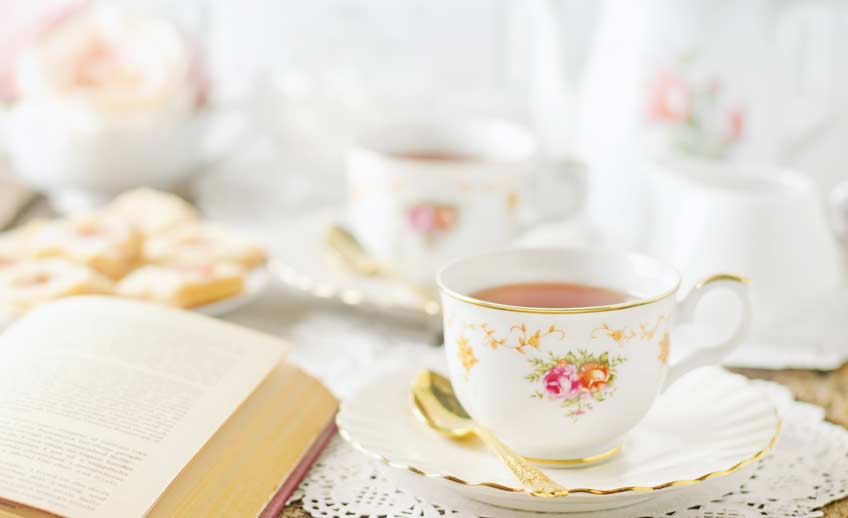
Sometimes you realize you have turned a corner, that you have a reason to celebrate. I had such a revelation during the spring after my husband died of kidney cancer the previous February, when I invited three ladies to my house for a little get-together, never dreaming it would turn into a significant day that included a tea party! When you were a child, you may have had tea parties. Or maybe, as an adult, you observed young children pouring cups of tea for themselves or their guests. Perhaps you have memories of watching children tip their heads back to swig down the last drops of their tea—just for fun. So tea parties can be fun little social events, but serving a cup of tea to someone else at a pretend tea party during play therapy can be an even bigger event to celebrate! I found that out when I worked with very young children several years ago, using play therapy as a tool.
Play therapy is usually for children ages 3 to 12 who are struggling with issues, and it is provided in a playroom with a therapist and selected toys. The child gets to choose the toys and activity, and the therapist provides a safe environment while participating in the child’s play in a non-directive, non-judgmental way. For children, play is their work. Through play, children learn to have fun, mimic adult behaviors, interact socially, and express their feelings when they cannot put their feelings into words. Symbolically, through play, children can “tell” or “show” what they are feeling through their actions, and a therapist can help children learn to trust and care about others.
In the playroom where I worked, there were child-sized pieces of furniture and a playhouse large enough for a child and therapist to fit into. Until a child developed a trust relationship with the therapist, sometimes the child pretended to lock the therapist outside. As a trust relationship developed, the therapist might be invited inside. At first, if a child chose to have a tea party, the child might only pour tea for himself. But as a child learned nurturing behaviors, he would pour tea for the therapist, demonstrating caring behavior which was likely an indication of healing.
Back to that spring after my husband died and my revelation. Prior to my husband’s death, I cared for others, and I took care of him after he became very ill. After his death, I was so devastated I could hardly get through the days that followed, much less care for anyone else. Before that particular day, I had not invited anyone to the house for a meal, and I seldom baked anything. I did not have the incentive nor the energy.
But when I learned that three other ladies who lived nearby had also experienced the deaths of their husbands, I decided to invite them to go on a walk at my old farmhouse in the country. I kept a walking path cut around the pasture, and I enjoyed walking the path in the evenings as the sun went down. I thought they might like it too. Before the ladies came, I bought some cookies at the store and made some iced tea to serve after our walk. When they arrived, we walked the path together, chattering as we walked. It was so good to be with ladies who understood each other. After our walk, we went into the kitchen, and I served the store-bought cookies and freshly-brewed iced tea—not really a big deal, but it was a big deal for me!
Temporarily, we all seemed to forget our sadness, even though we were all devastated by our losses. We were just four friends together, caring about each other! After the ladies left, I had a wonderful ah-ha moment—my revelation! I had just had my first tea party after my husband’s death—an exciting thought which gave me a spark of hope for the future! Even though I did not have enough energy to make homemade cookies, the store-bought ones were my beginning—one tiny step. And maybe there was a chance that my heart would heal, that I would trust life again and have the energy to care about others again too.
Just like for the little ones in play therapy, maybe the pain in my heart would not last forever. I hoped there would be more tea parties, more friendships. I felt an assurance that my heart was beginning to heal. After my very first tea party, I had reason to believe that I would have a future and that life would go on!
Teatime is by its very nature a combination of small luxuries arranged
in social symmetry. And the addition of a circle of dear friends
to share it with ensured the whole is larger than the parts.
(Author unknown)
Call about the next "Living Life after Loss" Group at:
Meadowlark Hospice
709 Liberty, Clay Center, Kansas
(785) 632-2225
Dawn Phelps, RN/LMSW, Group Facilitator